
Performance Review Sheets
Fair, useful performance reviews need a clear structure: what the person set out to achieve, how they did against it, the evidence, and what happens next. These editable review sheets give managers and employees a consistent format — self-assessment, manager review with a defined rating scale, 360 feedback, goals and development plan — plus an Excel tracker that calculates weighted scores across a team.
- Instant download
- Editable Word & Excel
- Print-ready PDF
- 7-day refund
7 files · DOCX, PDF, XLSX
Performance Review Templates
Editable employee self-assessment, manager review form, rating scale guide, 360 feedback form, goals and development plan, review meeting agenda and an Excel team review tracker with weighted scores.
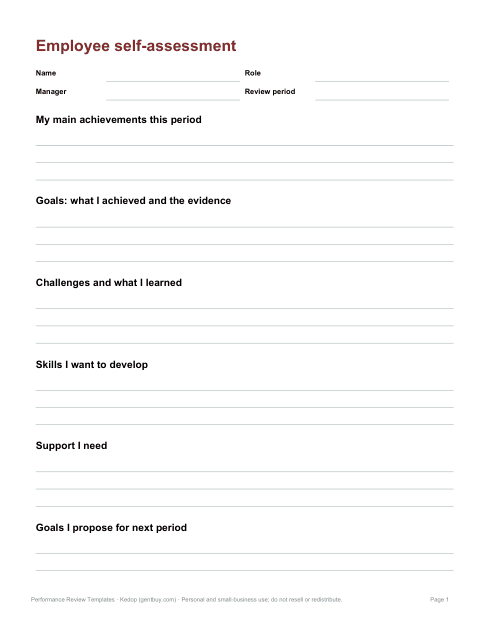
- Self-assessment (DOCX/PDF)
- Manager review form (DOCX/PDF)
- Rating scale (PDF/DOCX)
- + 4 more
$8.00 USD, one-time 7 files · about $1.14 each
- Instant download
- 7-day refund
- Secure checkout by Stripe
7-day money-back guarantee. Full refund within 7 days of purchase, even after you download.
Free sample: Employee Self Assessment (PDF, 56 KB)
Performance Review Templates
Editable employee self-assessment, manager review form, rating scale guide, 360 feedback form, goals and development plan, review meeting agenda and an Excel team review tracker with weighted scores.
- Self-assessment (DOCX/PDF)
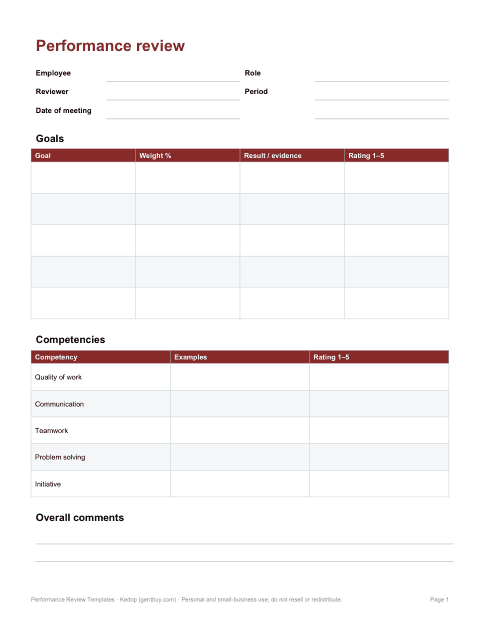
- Manager review form (DOCX/PDF)
- Rating scale (PDF/DOCX)
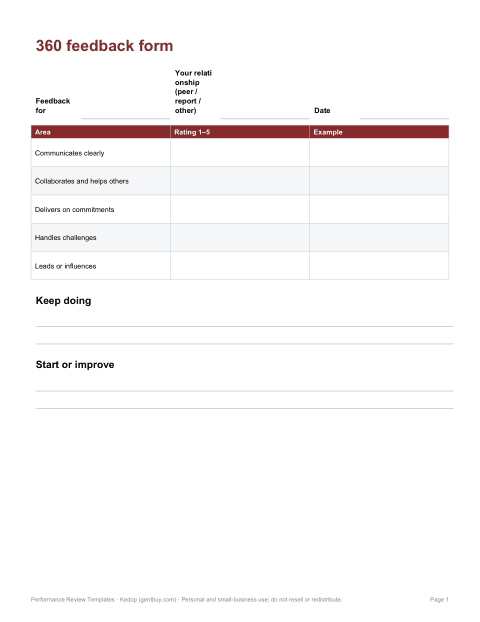
- 360 feedback (DOCX/PDF)
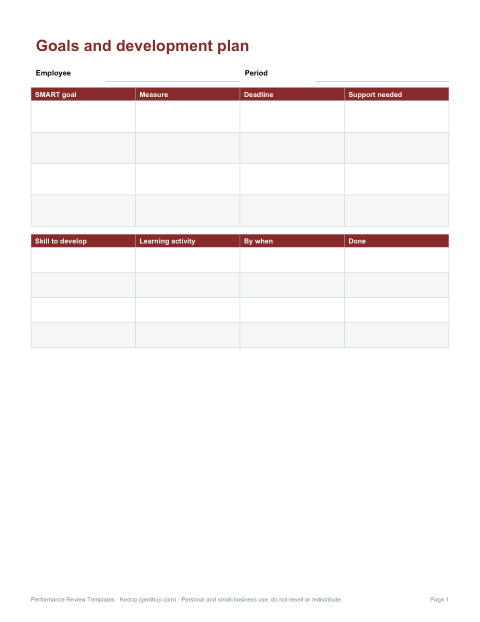
- Development plan (DOCX/PDF)
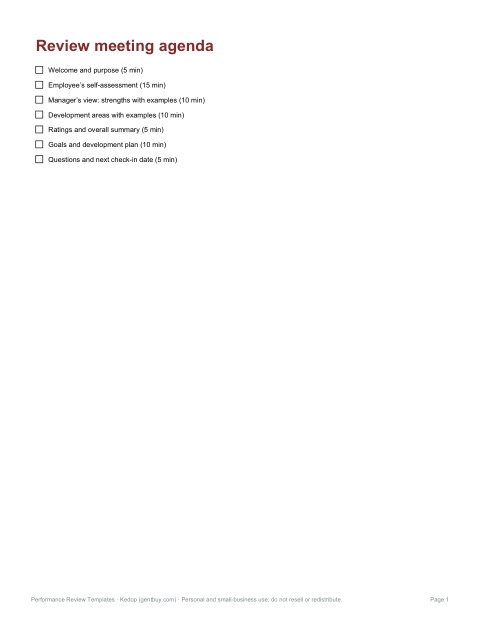
- Meeting agenda (PDF, DOCX)
- Team tracker (XLSX)
Formats: DOCX, PDF, XLSX. Instant download after payment (link valid 72 hours, up to 5 downloads). AI-assisted: the templates were drafted with AI help and reviewed and laid out before publishing.
$8.00 USD, one-time 7 files · about $1.14 each
- Instant download
- 7-day refund
- Secure checkout by Stripe
7-day money-back guarantee. Full refund within 7 days of purchase, even after you download.
Free sample: Employee Self Assessment (PDF, 56 KB)
Full refund within 7 days — see the refund policy and license.
Free printables
Single sheets you can print right now, no sign-up. The full pack adds every sheet in one download plus the editable files.
 Printable Self-Assessment Form3 pages · free PDF
 Printable Manager Review Form2 pages · free PDF
 Printable Performance Rating Scale1 page · free PDF
 Printable 360 Feedback Form1 page · free PDF
 Printable Development Plan Sheet1 page · free PDF
 Printable Review Meeting Agenda1 page · free PDF
 Printable Team Performance Review Tracker2 pages · free PDF
What is in the pack
| Template | Used by | Purpose |
|---|---|---|
| Employee self-assessment | Employee | Reflect on achievements, challenges and goals before the meeting |
| Manager performance review form | Manager | Rate goals and competencies with evidence and comments |
| Rating scale guide | Both | Define what each rating means so scores are consistent |
| 360 feedback form | Peers, reports, stakeholders | Gather structured feedback from colleagues |
| Goals and development plan | Both | Agree SMART goals and learning for the next period |
| Review meeting agenda | Manager | Keep the conversation focused and balanced |
| Excel review tracker | Manager / HR | Track scores, weightings and completion across a team |
A clear rating scale
| Rating | Label | Meaning |
|---|---|---|
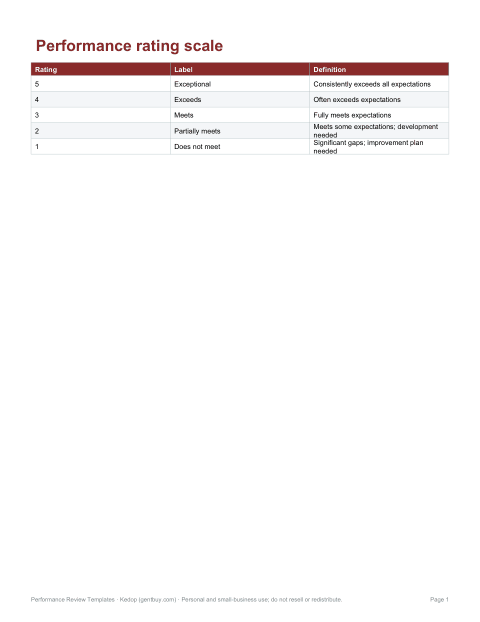
| 5 | Exceptional | Consistently exceeds all expectations; role model |
| 4 | Exceeds | Often goes beyond expectations |
| 3 | Meets | Fully meets the expectations of the role |
| 2 | Partially meets | Meets some expectations; development needed |
| 1 | Does not meet | Significant gaps; improvement plan required |
Agree the definitions before reviews begin and share them with employees. Consistent definitions are the single biggest factor in fair ratings across managers.
How to run a good review
- Ask the employee to complete the self-assessment a week before.
- Collect evidence: goal results, examples of work, feedback from others.
- Complete the manager form, rating each goal and competency with specific examples.
- Meet in a quiet space and let the employee speak first about their self-assessment.
- Discuss strengths, then areas to develop, using examples rather than labels.
- Agree goals and a development plan for the next period.
- Both sign and date the form; share a copy and follow up regularly.
Writing useful comments
- Be specific: “Reduced invoice processing time from 5 to 3 days by redesigning the approval flow” rather than “Great work on invoices”.
- Describe behaviour and impact, not personality.
- Balance strengths and development areas.
- Link feedback to goals and competencies.
- Avoid comparisons with other employees.
- Write as if the employee will read it — they will.
Weighting goals and competencies
Many organisations weight goal results and behaviours (competencies) — for example 60% goals and 40% competencies. The Excel tracker multiplies each rating by its weight and adds them up to give an overall score between 1 and 5, so reviews are comparable across a team. Adjust the weights to match your organisation’s approach.
Worked example
A customer support lead has three goals: reduce average response time (weight 30%), raise customer satisfaction (30%) and train two new team members (10%), plus competencies worth 30%. Ratings of 4, 3 and 5 for the goals and 4 for competencies give a weighted score of 0.3×4 + 0.3×3 + 0.1×5 + 0.3×4 = 3.8 — between “meets” and “exceeds”. The development plan adds a coaching course and a goal for next quarter.
Fairness and legal considerations
Base ratings on documented evidence and apply the same standards to everyone in similar roles. Keep reviews confidential and store them securely. Performance management and records are subject to employment law and your organisation’s policies; seek HR or legal advice for performance improvement plans, disciplinary issues or terminations. These templates are general and are not legal advice.
Formats
Editable Word forms (.docx) with PDF versions, and an Excel tracker with weighted score formulas. They work in Microsoft Office, Google Docs and Sheets, and LibreOffice.
Frequently asked questions
What should a performance review include?
Goals and results, competencies, evidence, ratings, comments, development plans and signatures.
How often should reviews happen?
Many organisations hold formal reviews annually or twice a year, with regular check-ins between.
What is a 360 review?
Feedback gathered from peers, direct reports and other colleagues as well as the manager.
How do weighted scores work?
Each rating is multiplied by its weight and the results added to give an overall score.
Are these templates legal advice?
No; follow your organisation’s policies and local employment law.
Was AI used to create the templates?
Templates were generated by script and example text drafted with AI assistance, then reviewed before publishing.